by Catrina Ziade, Raffi Yalenezian, and Jad Rammal
The Digital humanities offer us many interesting tools and methods, allowing us to analyze the humanities with another perspective. Indeed, by producing and using new applications and techniques, digital humanities makes new ways of research possible, invariably in an easier and quicker manner. The tools are designed to give you multidimensional eyes that can scan and visualize multiple lengthy texts within seconds, things you could never do alone as a human being. In this blog, we will be presenting two digital tools that we have already encountered in our digital humanities course: CliC and Voyant Tools (VT). In addition, we will show how these tools can help us in answering some research questions regarding our final DH project.
CliC demonstrates to us how computer-assisted methods can be used to study literary texts and lead to new insights into how readers perceive fictional characters. In order to show what CliC can offer us, we have chosen two corpuses we previously worked on in class, which are the following:
– Dracula (Bram Stoker) and Frankenstein (Mary Wollstonecraft Shelley)
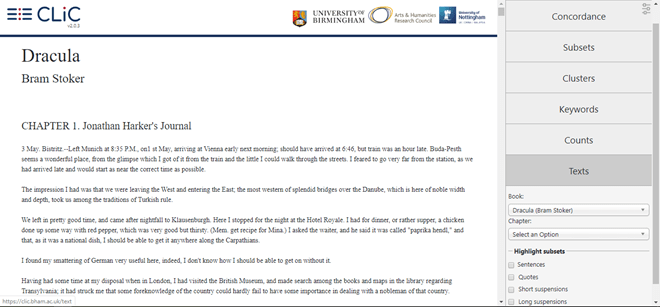
First, in order to access the corpus you are interested in reading, go to “Texts”, then type the name of the book you want in “Book”, and select it. You can also directly access a specific chapter without the need to scroll down, by going to “Chapter”.
In addition, by going to “Counts” and selecting the corpus you want, you can see the total number of words in this corpus. Moreover, you can select several corpuses at the same time as shown above, to compare their length. Indeed, we can see that Dracula has almost twice the length of Frankenstein (160,485 words vs 74,963 words, respectively).

Some of the research questions we had in mind were:
– Who is the most powerful monster, and how it is manifested through each text (Dracula and Frankenstein)
– What are the characteristics of each of these monsters, and what distinguishes them?
In order to answer these questions, we used several tools offered by CliC.
First, we used Concordance to answer our first question, by comparing the usage of the word “fear” by selecting All text in “Only in subsets”.
Fear is used many times in Dracula (134), mainly by Harker, the prisoner of Dracula, to express his feelings in his Journal towards Dracula’s action from the day he met him:” I am in fear, in awful fear, and there is no escape for me”. Indeed, Dracula is described as a vampire, and a vampire is an undead creature who causes mischief or deaths of the people in the neighborhood, which is a main reason why fear is used by Harker and his accomplices to describe their feelings.
On another hand, the monster created by Frankenstein was abandoned by the latter because he was disgusted by the “thing” he had created. In fact, Victor shows no sense of fear towards his monster but is seen arguing with him and shows sympathy towards him. In fact, thanks to CliC, we were able to see that fear is mostly used (about 40 times) in the second half of the novel and it is mainly where Frankenstein expresses his regret towards what he has done: “I had been the author of unalterable evils, and I lived in daily fear lest the monster whom I had created”.

Upon close reading we suspected the frequent usage of the words “misery” and “despair” (54 and 49 times respectively) in order to answer our questions.
Frankenstein’s monster is the classic story of the experiment gone wrong. He is a monster created by man, and then rejected by man. He is cast into the shadows and marginalized for his hideous form.
Indeed, Frankenstein did not ask to be a beast; he was simply made that way. Hence, he feels the despair and loneliness that comes with being a monster, which can be proven by the frequent occurrence of the words “misery” and “despair”. Some examples are the following:
- “I am sorry that I am still alive to feel this misery and horror.” (Chapter 21)
- “the overflowing misery I now felt” (Chapter 23)
- “No guilt, no mischief, no malignity, no misery, can be found comparable to mine. […] I am alone.” (Chapter 24)
- “Anguish and despair had penetrated into the core of my heart” (Chapter 8)
- “torn by remorse, horror, and despair” (Chapter 8)
So, Frankenstein is presented as someone to be pitied: he is shown as the victim, rather than the oppressor: a victim of circumstance. His fate has, in a sense, been settled against his will. He is a human mind living inside a body that can never be human.
Then, Frankenstein becomes the villain, stalking down his creator for revenge, which is clearly shown by the lexical field of revenge that is used frequently (revenge is used 24 times, vengeance is used 21 times…). The following quote shows how much rage Frankenstein is feeling because of him being a monster, and his ultimate quest for revenge:“revenge remains—revenge” (Chapter 20).
Dracula kills humans by draining them slowly, night by night, and he does it with no remorse. Unlike Frankenstein’s monster, he seems to have no origin. He is more of a mythical beast, which makes him a more powerful figure.
Indeed, Frankenstein’s monster is a slave to the forces of man: he is not like Dracula, a monster independent of the circumstances around him; the circumstances are contingent on his being. In fact, he has not chosen his monstrosity like Dracula, who is a force beyond man. Indeed, unlike Frankenstein, Dracula’s quest is never vengeance, but eternal preservation.
In addition, Dracula is a very powerful character to the extent that he seems to be defying God; he is absolutely evil. For example, Dracula’s powers are limited during the light and his powers are stronger in the night, during darkness. This can be shown by the frequent usage of the semantic field related to night, like “darkness”, “dark”, “shadow”…
By reading our texts more closely we questioned the idea of Evil vs Good for both characters.
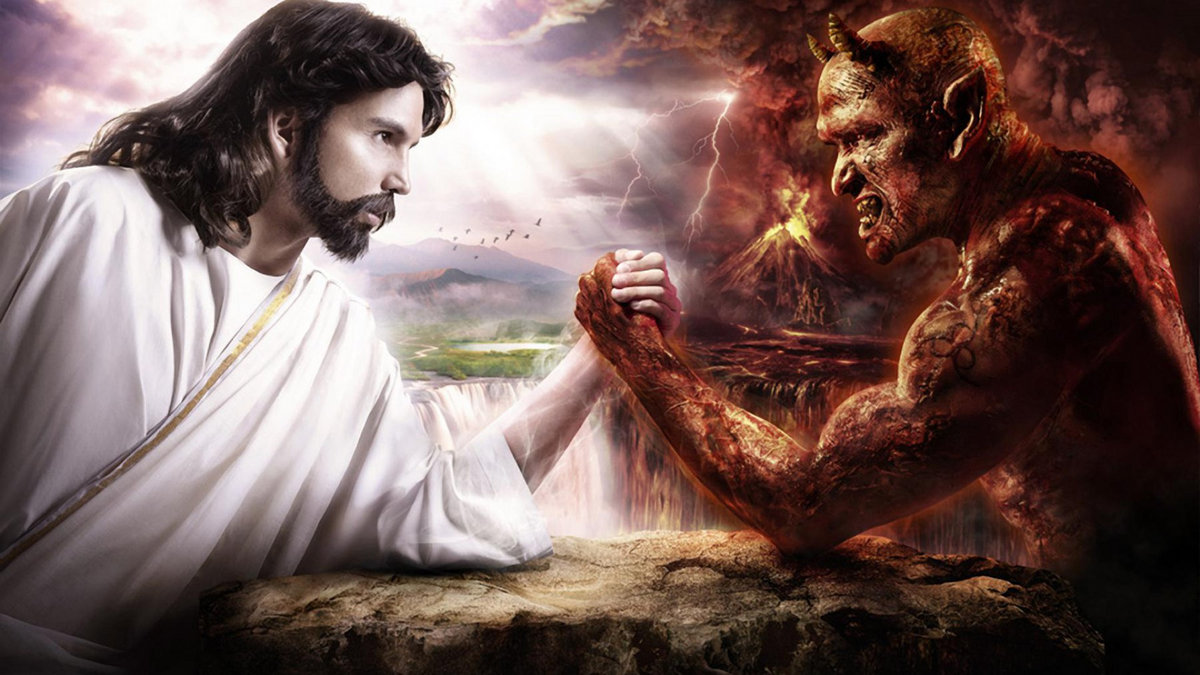
In some religious texts, God is referred as being the light, which confirms that Dracula isn’t a man of God. In fact, killing innocent people just to prove himself does portray the Anti-Christ in him, because Christians believe that taking the life of a child of God is a sure-fire way of going to hell (The Ten Commandments), which surely puts him in the category of demonic.
Moreover, Dracula has several powers that the Christians believe no one but God could control, which shows his unchristianity. For example, Dracula can control the weather (“owing to such weather influences as we know that the Count can bring to bear”(Chapter 24)), wild, or some animals. This shows Dracula’s defiance toward God and all Chrisitanity.
In addition, throughout the novel, many biblical allusions are used to show the god-like manner of Dracula, such as “ The blood is the life! The blood is the life!” (Chapter 11). This quote shows that consuming human blood gives vampires fortification and youthfulness, but in a damning and demonic sense. Thus, in Stoker’s novel, vampires drink human blood partly to mock and subvert Christian theology.
For instance, as Dracula moves to Carfax and begins his journey on to feeding on his victims, just as God had his disciples, Dracula has his followers as well. Renfield is a prime example of Dracula’s disciple: “I am not even concerned in His especially spiritual doings. If I may state my intellectual position I am, so far as concerns things purely terrestrial, somewhat in the position which Enoch occupied spiritually”(Chapter 20). Moreover, when Renfield discusses Dracula, Dracula’s name is always capitalized; in Christ, most people would refer to God in that manner, which shows again that Dracula is defying God.
Moreover, the monster created by Frankenstein is described as both Adam and Satan. In fact, he was created by Victor and is curious about the life he is given by asking him for a mate. The Monster explicitly identifies himself with Adam when he recounts his history to Victor and says, “I ought to be thy Adam.” On another hand Like Satan, the cast-aside Monster lives in hell (what the world has become after he is rejected). Although the Monster murders many of his creator’s friends seeking revenge, he is also capable of kindness and compassion when he saves the life of the drowning girl.
Back to distant reading, by selecting “Quotes” in “Only in subsets”, we saw that Dracula makes more usage of the word blood, since he was half-man, half-bat with a thirst for human blood.
In fact, in Dracula, blood is illustrated as a source of life: “The blood is the life! The blood is the life!” and a “too precious a thing in these days”. In fact, Dracula and the three women vampires crave human blood and drain their victims of their blood, and Renfield gets his sustenance from the blood of insects and small animals. But also, Dracula sees blood as a source of intimacy or a way to express his sexual desires by not only using blood to feed himself but he makes Mina, the women he loves, drink his blood. Furthermore, Arthur defines blood as life in order to save his wife: “Tell me, and I shall do it. My life is hers, and I would give the last drop of blood in my body for her.”
Dracula is also associated to Evil by disobeying the word of God: ‘do not eat the blood because the blood is the life.’ The Evil One gets his strength by directly disobeying this command from the Bible.
By doing this analysis, we concluded that Frankenstein’s monster is a monster created by man, whereas Dracula is a beast in his own nature and was not derived from man’s doing.
Moreover, we showed that Dracula, the most powerful being is the supernatural. In addition, Dracula will seek any means to live on as a God for eternity, taking any means necessary. Although both characters represent fear and terror, and take part in monstrous activities, Dracula is a force beyond man, he is a monster who appears to be a man.
From our point of view, we found that CliC was user-friendly, and easy to use. Indeed, with the help of our ENGL256B PowerPoint, we were guided step by step by our professor Jarkas, which made our experience with CliC more comfortable.
Advantages vs Disadvantages of CLiC
The main advantages of CliC is that it allows you to look at words’ frequencies accurately, in a much faster way, without relying on human memory. Moreover, it allows you to examine themes more closely, and see if the emphasis of certain ideas is consistent with the use of the language.
Furthermore, like any other digital tool, CliC has disadvantages too. Indeed, word frequency is a limited assessment when searching for more complex or vague ideas. Moreover, it doesn’t do the analysis for you, so you still have to do close reading. In addition, the range of books and corpuses available are limited, like the problem we faced: we didn’t find any texts related to the author we wanted to do our Digital Humanities Final project on: Hans Andersen. However we were able to find and upload Andersen’s texts onto Voyant Tools, a platform you can upload any text from the internet onto.
Hence, this is one of the reasons why Voyant Tools is a much more efficient tool as compared to CliC.
CROSSOVER TIME!
We used Dracula and Frankenstein as initial experiments with CLIC because we were fascinated the concept of “evil monsters”and they were already present within the tool corpus, but for our research project we decided we wanted to work with Fairy Tales, specifically Hans Andersen’s. So much of our childhoods had already been shaped by his works, so we thought it would be even more interesting to go back to the beloved works that had influenced so much of our lives growing up, and see what new things we could now find with our 21-year-old minds and newly acquired digital tools.
However, before we introduce the second tool we will be using for our DH project, which is Voyant Tools, we realized we were surrounded by so much evil in not only the Gothic novels but the Fairy Tales we were about to go mining in with Voyant Tools. Thus we reached the conclusion each genre had its own portrayal of what shape or form evil takes.
In Gothic literature, evil takes the form of a “monster” such as the vampire Dracula or the monster Frankenstein, but symbolizes something beyond the monster; a deep rooted issue within society. The monster is only the tangible physical manifestation.

Frankenstein is a monster, a humongous disfigured creature, yet intelligent and sensitive. It terrorizes the town and its creator after it is socially rejected due to its ugly deformity. Thus the “Evil” represented through the monster is deeper than the terror the monster inflicts upon everyone. The true “Evil” lies within not the monster itself, but behind the creator Victor. The “Evil” lies in the irresponsible use of science, the irresponsible desire to play “God”. The creature is just reacting to society in a way that an oppressed human would. It is due to Victor giving life to an intelligent and sentient being that was born to be rejected in society, as society is superficial and places the utmost importance upon physical appearance.

In Dracula, vampires are the embodiment of moral degeneration. Blood drinking in the bible is explicitly stated as evil. “And as I gave you the green plants, I give you everything. But you shall not eat flesh with its life, that is, its blood” (Genesis 9:3-4). And causing others to become vampires is synonymous with infecting them. Thus the thirst for blood of a vampire ultimately equates blood with sin. The novel was written during the Victorian era, a time notorious for its rigid and repressive Christian views.
Thus Dracula is a physical representation of the sinfulness of deviating from Christianity infecting society, and thus corrupting it from within; echoing the main Victorian fears during the era.
Now In fairy tales, evil comes in many shapes in forms, not necessarily in the sense of a monster in gothic literature nor in the sense it is “disfigured” or it is a treacherous being. Evil comes in the form of a character who challenges the main protagonist’s goals, and makes it incredibly difficult or impossible for our beloved protagonist to achieve them, at least in our selection of fairy tales; specifically “The Steadfast Tin Soldier”, “The Ugly Duckling”, and “The Little Mermaid”.

In the “Steadfast Tin Soldier”, evil takes the form of a “jack in the box” who also has his eye on the love interest of the soldier; the tiny ballerina. And when the soldier ignores his warnings, the jack in the box pushes him out the window of the house, and away from ever being with his love.

In “The Ugly Duckling”, evil lies in the way the duck is disrespected by everyone around it; thus preventing the duckling form ever accepting itself with love.

And in “The Little Mermaid”, evil lies within the Sea Witch, who does give the mermaid legs to help her unite with her love interest the prince, but takes away her voice in exchange, preventing the mermaid from being able to bond with the Prince, and even more heartbreakingly; preventing the mermaid from being able to reveal herself as the woman who had saved the Prince from drowning, the woman he has been searching for ever since. Even though she is right there on land with him, she cannot reveal herself as his true love as she has no voice.
Now onto our second tool: Voyant Tools.
Voyant Tools is an open-source, web-based application for performing text analysis, and it can be used to analyze online texts or ones uploaded by users.
Unfortunately, Andersen’s texts were not on available on CLIC, but with the texts we acquired on www.gutenberg.com , we could use Voyant Tools to explore our beloved works.
In order to perform our analysis, we chose our aforementioned three Hans Andersen’s fairy tales:
– The Little Mermaid
– The Ugly Duckling
– The Steadfast Tin Soldier
We found these texts in the following website https://www.gutenberg.org/, where you can find free eBooks. Then, we saved the fairytales we selected on Word Document as Plain Text, in order to upload them on Voyant. Our choice was based on the project title we selected: Love and Transformation in Hans Andersen’s fairy tales.
Voyant Tools lives up to its name; it comes with several text-mining tools which enable you to simultaneously read your text/s distantly and closely. Its tool “Cirrius” gives you the words with the highest frequencies, and you can even expand the list to see words with even lower frequencies. You can look at the distribution of these words through the “Trends” tool. You can also look at where and when words were said and what came before or after them through the “Context” tool, where you can also read the passage in which the word is being used, enabling you to closely examine the context. And another close-reader favorite, the “Reader” tool, which can be used to locate specific words and where you can read not just the passage in which the word is used but the entire text itself.
Initially, our research question was simple and broad; how does Andersen use language to convey the theme of “Transformation”. However, through Voyant Tools, our questions became more specific and several other questions were raised in relation to our original idea.
We began with “The Ugly Duckling”. Naturally, our first instinct was to look at the word frequencies Cirrius gave us, specifically for the words “Ugly” and “Beautiful”, as we hoped we could find some clues to our research question. But the word frequencies told us nothing. It was the “Trends” tool that helped us solve our mental mystery. The trends of both words were almost matched at the end; which highlights the idea that the transformation may indeed be physical, but the “ugliness” of the duckling is still as tied to its identity as its newfound beauty. This pertains to our project as a subpart of our research question in whether the theme of “transformation” is in concordance with Andersen’s life, as he was ostracized his entire life and only deemed a worthy human being after moving to Copenhagen and becoming a successful author.

Image Source: Hans Christian Andersen – Wikipedia
It is said that the impact of being so ostracized for so long never left him, and that this is conveyed through the melancholy of his fairy tales. What we found for “The Ugly Duckling” seems to support this. We used the “Reader” tool for some close reading and found it interesting to note that the story ends with the ugly duckling being transformed into a swan saying “I never dreamed of such happiness as this while I was the despised ugly duckling.” Thus, instead of the duckling embracing his new identity, he ties it to his old one, supporting our hypothesis about Andersen.

For “The Little Mermaid”, the word frequencies once again told us nothing. But the “Trends” tool is what inspired us and helped us guide our research question. We looked at the trend of the word “Beautiful”, and noted an interestingly significant drop. We decided to use some close reading to find out where and why this might be. From our background knowledge about the novel, we knew that Andersen’s caveat in the story was the danger of beauty and how misleading beautiful things or people are; they may be beautiful but they can bring you more misery than you ever bargained for. Thus, the admiration of and desire to be close to beauty can often come at a price.

Using close reading; we were astonished to find that the drop in the word “beautiful” is where the beauty lies in not what can be seen, but what can be heard. It is the scene where the little mermaid sings during the court ball. The word “beautiful” is not even used once in the scene; despite that we know voices are conventionally described as “beautiful”. Andersen chooses the word “sweet” instead to describe something so ethereal and beautiful as the mermaid’s voice. “Sweet” is an adjective that you cannot admire with your eyes, but with the senses. It is an entity even someone blind can admire and appreciate.
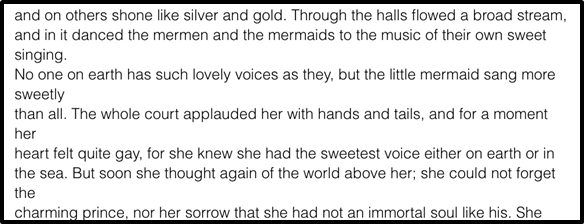
This raised important questions to us, enabling us to go even further than our research question; How is the word “sweet” used in “The Little Mermaid” and how. Why is this significant? What point is Andersen trying to make about “beauty”? How does Andersen further his caveat about “shallow beauty” through his language?
We were thrilled with our discoveries and the new ideas VT gave us. Every answer we found came with more questions.
We looked once again at the word trend for the word “beautiful” and the word frequency Cirrius gave us (49). From our background knowledge about the novel, we knew that Andersen’s caveat in the story was the danger of beauty and how misleading beautiful things or people are; they may be beautiful but they can bring you more misery than you ever bargained for; that the admiration and desire to be close to beauty can often come at a price. The use of the word beautiful is misleading if the context reader is not used for close reading. As you can see through the graph and Cirrius, one may think at face value that “beauty” is emphasized through the story through the word frequency and the trend. But everything labeled “beautiful” in the fairytale is not as beautiful as it seems and will only bring the little mermaid pain. Close reading was thus essential. For everything explicitly called “beautiful” in the fairytale, something must be given up to enjoy it, or something beautiful must be given up to enjoy it (i.e. the mermaid’s voice to gain legs). The “Context” tool verified this, as the word “beautiful” was always used to describe the town on land, the things on land, the prince, his eventual bride… all of which the mermaid gave her voice for, and eventually her life.
For our final text “The Steadfast Tin Soldier”, Cirrius once again seemed bland. There was nothing notable about the words with the highest frequencies; they seemed self-explanatory. However, when we expanded the list of Cirrius to words with lower frequencies, we discovered that Cirrius isn’t just for telling you what words are used the most, but it can also tell you what words are used the least. When an author uses a word sparingly (between only once and up to three), it can either just be a simple coincidence or an insignificance, but it can also be for the exact opposite; the author can place so much emphasis on the word; making the meaning behind it ever more significant.
We decided to look closer at the word “heart”, one of the words with the lowest frequencies (3), which seemed relevant enough to the story, as we know the soldier is not only steadfast because he’s always standing even with one leg, but he is steadfast with his heart as well: his love for the toy lady dancer is as steadfast as he is, never flailing. We used trends to look at this from another perspective. Through the trend observed, his “heart” is never mentioned until the very end, as it is here where he is transformed into his true self, not a soldier with only one leg, but a heart of tin that even fire cannot melt. We were satisfied as this strengthened our evidence for our research question.
However, this raised another important question, how many times is love used? We once again increased the range of Cirrius to find the word with lower frequencies, and interestingly enough “love” was only used once; and using the “Reader” tool, we corroborated why it is so significant; the word love is only used during the transformation of the tin soldier into the tin heart when he is cast into the fire: “The heat he felt was terrible, but whether it proceeded from the fire or from the love in his heart, he did not know”. Love is only used once and it is to mark that it is not the fire that transforms the soldier, but the realization of the love he has in his heart.
We were having so much fun with our discoveries, that we decided to use VT to examine all 3 texts from a distance and see if we could find anything. What stood out at first in Cirrius was the word “Water” in a big green font, indicating that it was one of the words with the highest frequencies across the texts.

We asked ourselves why, and remembering the events of the stories, we noted that Andersen could be using “water” as a medium for transformation. So we asked ourselves how water was expressed as a medium for transformation in the stories. Voyant Tools not only enabled us to initially spot this by giving us the word frequency, but we used Trends to examine the trend of water within each one.


Blue: The Little Mermaid, Green: The Steadfast Tin Solider, Pink: The Ugly Duckling
Close reading of course, was a must to verify our hypothesis, so we resorted to the “Reader” tool for each one to closely look at the context and see if it corroborated our attributed meanings behind the trends.
In the “Steadfast Tin Soldier”, water is the catalyst which ultimately brings the soldier back to the house, where he will be “transformed” into the true representation of himself: a steadfast tin heart.
In “The Little Mermaid”, the use of water is consistent, and makes sense as “water” is tied to the Little Mermaid’s identity. Even though the mermaid gains her legs and becomes a human, she cannot escape the world of mermaids and mermen. It is also ultimately where her voice is kept by the sea-witch, the key to her identity and soul. Thus she is always tied to water. It is also interesting to note that it is in water where she is transformed into a human, symbolically emphasizing that her identity is tied to this world even further. And in the end, when she dies, she transforms into a child of air by dissolving in sea foam.
In the Ugly Duckling, water is emphasized in the beginning of the story and then at the end, which each respectively mark the transformation of the duck into the ugly duckling (identity wise), and the ugly duckling into the swan at the end (physically wise). We used “Trends” to verify this and the two peaks at the beginning and end corroborate each transformation.

Now you may wonder, why did Andersen choose water? We asked ourselves this, and doing some quick research, we found that for the longest time, since the ruminations of the Ancient Greeks to the theory of the psychologist William James in the late 1890s, our stream of consciousness has been considered like a river of water, where thoughts and emotions and imagination are all one and flow together, constantly in flux. It is during the flow of our stream of consciousness where we have our greatest spiritual and mental transformations; arguably in Andersen’s perspective and now ours, the only transformations that truly matter in the grand scheme of life.

Image taken from https://quotefancy.com/thales-quotes
Looking back, Voyant Tools was quite daunting at first. We had to refer to the PowerPoint of Professor Jarkas again to remember how to use it and what to use it for. The graphs with all the clusters seemed intimidating and quite frankly speaking, we panicked because we didn’t know what they meant. However, once you learn what each tool is for and how you can manipulate them, Voyant Tools becomes a breeze and it’s quite reinforcing to use when you know what you’re specifically looking for.
Our only wish is that Voyant tools had more tools to look more closely at context, especially for lengthier texts where close reading would be very time consuming. For example; if it could specifically examine the use of specific adjectives and interpret the context for us rather than us having to read and do it. In other words, we wish VT could do the close reading for us!
But using Voyant Tools, we noticed the importance of close reading over distant reading. Indeed, distant reading, in our opinion, is useless without close reading. We realized word frequencies tell you nothing unless you are fully aware of the context and themes of the texts you are dealing with, so you yourself can find the reason behind the trend or word frequency VT gives you, or whether the trend/word frequency VT found actually matters or not.
The main advantage of VT is that once you have these themes and contexts in mind, you don’t have to find the patterns, VT finds them for you, and once it does, then you can delve even deeper to your texts with close reading. In fact, no one is going to count word frequencies or word trends for lengthy texts, especially multiple ones. So VT is ultimately a lifesaver, truly, but it’s not going to do the close reading for you.
In conclusion, our moral of the story is not to lose yourself in the numerous colorful graphs and words you see in VT. Indeed, keep a guiding idea in mind, and use it to maneuver around what VT shows you. In simpler terms, if you don’t know how to swim, don’t jump into the water.
 Jad's Blog