By Catrina Ziade, Raffi Yalenezian and Jad Rammal
It is strange how things turn out sometimes.
We were thrust into the same group together because none of us had a group to begin with and we were the last ones left. Little did we know that we had a lot in common-namely our love for Hans Christian Andersen’s fairy tales. An awkward conversation suddenly turned into a bonding session on our childhoods and what our favorite fairy tales were growing up.
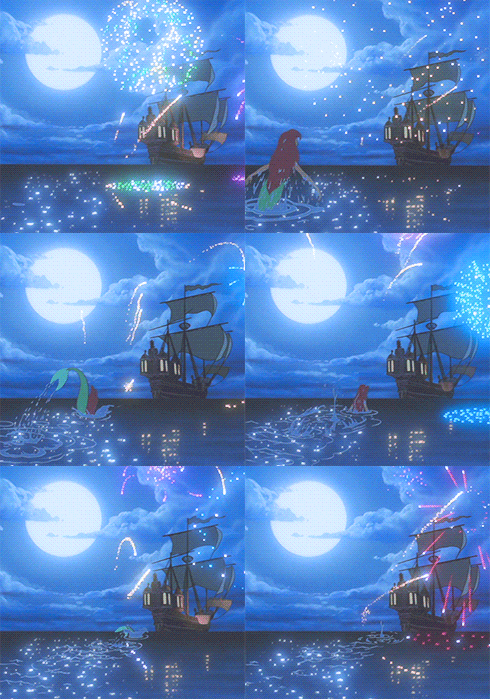
Catrina’s favorite fairytale was “The Little Mermaid”, referring to both the film adaptation and the original tale by Andersen. She spoke about how she was a huge fan of the love story between the mermaid Ariel and the human Prince Eric.

Image Source: https://www.zimbio.com
My favorite fairytale was “The Steadfast Tin Soldier”, referring to its appearance in the animated film Fantasia 2000. As a child he thought it was amazing that the soldier “soldiered” on despite the fact he only had one leg.

Image Source: https://www.deviantart.com/kirastfd/art/The-Steadfast-Tin-Soldier-511250326
And Raffi’s favorite fairytale was “The Ugly Duckling”, especially its appearance in Tom and Jerry, where the duckling feels so ugly it begs Tom the cat to eat him but Jerry prevents it from happening.

Image Source: https://www.youtube.com/watch?v=Lu8W8YlRR9A
While discussing what inspired us and what we loved about each fairy tale, we realized that our favorite tales coincidentally had a common theme: Transforming for love, Transforming because of love, and loving yourself after Transforming.
Thus we chose the theme of “Love and Transformation”, both in the physical and spiritual sense, as each character in each fairy tale goes through a transformation in one of the latter, with love or the seeking of love as motive.
Our main goals initially were to:
1. Explore the themes within each fairy tale
2. Explore how Andersen conveys these themes through his choice of language within each fairy tale and across all three.
However, while doing the analysis, we discovered that this wouldn’t be enough to fully understand the fairy tales, as the more we found out about Hans Christian Andersen, the more we realized that there was far more to these fairy tales than met the eye. In fact, these themes were in concordance with and inspired by his life. He was born impoverished and dyslexic, and he lived his entire life alone as every lover he ever pursued rejected him. Despite these hardships however, he turned out to be one of the most successful authors to have ever lived, and he continued to try and find a lover. However, though these fairy tales brought him great success, it seemed that, perhaps, behind each story was Andersen channeling his heartbreak through the ugly duckling, the love-sick mermaid, and the toy soldier with one leg. Thus we put forward the idea that “The Little Mermaid”, and “The Ugly Duckling” were metaphors for his unrequited loves, and that “The Ugly Duckling” is an autobiography about his transformation from poverty and failure to a successful author. We wanted to find out more. And so we added two more project aims:
3. Explore Hans Christian Andersen’s life and love life
4. Examine the fairy tales in relation to Andersen’s life events and unfulfilling romances -which are rumored to be the true inspirations behind/metaphors of the aforementioned fairy tales.
And so, our project was born, titled:
LOVE AND TRANSFORMATION IN HANS CHRISTIAN ANDERSEN’S “THE LITTLE MERMAID”, “THE STEADFAST TIN SOLDIER”, AND “THE UGLY DUCKLING”
Here is the link to our Timeline.
We recommend playing the song “Part of Your World” when you get to the slide that has it! It will enhance your emotional experience. 😊
At first, our project seemed very ambitious and daunting. We felt like we had so much to do and we didn’t know where to begin. We didn’t even know how we were going to be able to demonstrate our findings. All we had known in our entire academic life was Microsoft PowerPoint and Prezi (when we were feeling adventurous).
Little did we know that the tools we were going to discover would not only help us achieve our goals and surpass them, but would change our academic ability to present forever (this is not an exaggeration).
First, we were introduced to Voyant Tools, a savior in the disguise of, what seemed to be back then, very confusing graphs. Thanks to Voyant Tools, we were able to see EXACTLY how Andersen conveyed the theme of transformation within the fairy tales using language.
Voyant Tools initially allowed us to read the fairy tales, both separately and together, at a distance as its tool “Cirrius” provided us with word frequencies which gave us a start of what we should be looking at. Then, we looked at the word trends using the “Trends” tool to see if there was anything noteworthy about the words rather than just the frequencies. Then, close reading was a must as we used the Context and Reader tools to verify and elaborate on our textual findings, as these tools enabled us to read the passages including these words as well as the entire text itself.
Thus Voyant Tools was the perfect guide we needed to explore the themes as well as Andersen’s use of language in relation to these themes. Thanks to VT we were able to note interesting choices in Andersen’s language and an interesting pattern in the choice of using water as a medium for transformation.
Here are our findings, of course displayed on our Timeline (the tool, as we will later tell you in this blog, that we chose for a special reason).
The Little Mermaid

We knew Andersen’s caveat in the story was the danger of beauty and how misleading beautiful things or people are; they may be beautiful but they can bring you more misery than you ever bargained for; that the admiration and desire to be close to beauty can often come at a price. Thanks to Voyant Tools, we could look at exactly how Andersen conveyed this theme using language. Using the “Context” tool on Voyant Tools, we discovered that for everything explicitly called “beautiful” in the fairytale, something must be given up to enjoy it, or something beautiful must be given up to enjoy it (i.e. the mermaid’s voice to gain legs). We verified this even further with the context tool, and as a matter of fact, the word “beautiful” was always used to describe the town on land, the things on land, the prince, his eventual bride… all of which the mermaid gave her voice for, and eventually her life.
We now know Andersen got his heart broken by every beautiful lover he ever pursued, and so we were amazed that he managed to convey this message so subtly through the story as well his selective choice of language in it.
The Ugly Duckling

With Voyant Tools, we were able to spot the interesting trend of the words beautiful and ugly. We eventually discovered the reason behind this; the duckling ties his “ugliness” to his newfound beauty, saying “I never dreamed of such happiness as this while I was the despised ugly duckling”. Thus, VT helped us support our hypothesis about Andersen further, as the story proved to be in concordance with his life, as he was ostracized during the entirety of it and was only deemed a worthy human being after moving to Copenhagen and becoming a successful author. Yet loneliness still pervaded his life, as all his romantic endeavours failed. Thus, Andersen, though successful, was still an ugly duckling in the sense he was miserable – loneliness was forever tied to his identity.
The Steadfast Tin Soldier

Image Source: https://favim.com/image/422471/
Thanks to VT, we discovered how Andersen managed to place a great emphasis on the theme of “love” as a means to transformation through language – he only used the word “ love” once, though the soldier is in love with the ballerina throughout the entire story! When we used the “Reader” tool, we found out why the word was so significant that he only used it once; the word love is only used during the transformation of the tin soldier into the tin heart when he is cast into the fire: “The heat he felt was terrible, but whether it proceeded from the fire or from the love in his heart, he did not know”. Love, was thus only used once, and it is to mark that it is not the fire that transforms the soldier, but the realization of the love he has in his heart.
Water as a Medium of Transformation (Our main finding using VT examining the 3 tales at the same time)

Image Source: https://www.howitworksdaily.com/5-things-you-should-know-about-the-ocean/
Also, VT enabled us to analyze all 3 fairy tales from a distance, and we were surprised to find an interesting pattern thanks to the trends tool; we noticed the use of the word water was prevalent across all 3 fairy tales! When we used close reading to delve deeper, we were elated to find that Andersen, in fact, used it as a medium for transformation of the mermaid, duckling, and soldier, either spiritually or physically.
So, thanks to VT, we completed the first two goals.
✅Main Goal #1 Explore the themes within each fairy tale
✅Main Goal #2 Explore how Andersen conveys these themes through his choice of language.
We know we’ll be using VT in other literature courses should the time ever come we need to analyze a literary text!
Then came Google My Maps, a feature created in Google Maps that enabled us to create our own maps of the trajectory of Hans Andersen’s Life and Unrequited loves. The visualizations enabled us to map the important details about lovers of our author, which were essential to understanding and analyzing the fairy tales better. Google My maps allowed us to develop a map of Andersen’s life and unrequited loves, giving us a guide as to where to look to understand his fairy tales and what additional factors might have influenced them. It gave us more insight into his character because as we could see, for every accomplishment he had, there was always pain from an unrequited love tainting it. Through close reading, in depth research, and analysis, we explored how each fairytale was influenced by his life and lovers and thus, we found and strengthened the evidence we gathered for our final project.

We learned that Hans Christian Andersen had a very difficult childhood. After losing his father at the age of 11, he lived with his mother in a house shared with other families. He was then sent to a school where he was bullied by his classmates and his professors who criticised his writing and reading skills(he was dyslexic). Later, after impressing a man named Jonas Collin through a play he wrote, he was sent to the University of Copenhagen, from where he graduated and started his writing career. Andersen received a grant from the King which he used to travel around the world from which he was inspired in many of his fairytales. Despites his successful life as an author, Andersen led a very lonely life, as he never had the chance to build a relationship despite falling in love multiple times. At one point, he wrote in his diary: “Almighty God … Give me a livelihood! Give me a bride! My blood wants love, as my heart does!” His search for a lover was both local and international, where he searched for love in both men and women. Indeed, the first woman he fell in love with was Riborg Voigt, from whom he experienced rejection for the first time. He based one of his famous fairytales “The Steadfast Tin Soldier” on his undying love for her. He also experienced the unrequited love of Edvard Collins, the son of Jonas, whom he wrote“The Little Mermaid” about. Hans Andersen ended up alone in his house in Copenhagen during the last 3 years of his life, having accomplished a worldwide recognition for his writings, but failing to win the heart of any of his lovers.
✅Main Goal #3 Explore Hans Christian Andersen’s life and love life
Google My Maps, in fact, gave us the foundation for Main Goal #4, which was to analyze each fairy tale in relation to his life and love life, as now that knew enough about the “where” and “when” and “whos” of Andersen’s life achievements and unrequited lovers, we were ready to examine each fairy tale in relation to these intricate details, and in combination with our textual findings using VT analysis. Thus, thanks to these tools, we were capable of strengthening all the evidence for all of our goals at the same time.
Here are some of our findings for our Project. We really recommend you visit our Timeline to learn more. (We hope you’ll be just as blown away as we were!)
We learned that:
- The Little Mermaid was in fact an ode to an unrequited lover named Edvard Collins
The Little Mermaid, written in 1837, is perhaps one of his most autobiographical works. Indeed, Andersen fell in love with Edvard Collins, the son of Jonas Collins who paid for Andersen’s school education. The tragedy was that in Edvard’s mind, they were just friends, however, in Andersen’s mind, they were lovers. Andersen wrote several letters to Edvard Collins expressing his love for him, but they were rejected by the latter, causing much suffering for Andersen.

In the Little Mermaid, the mermaid fell in love with a prince; to be able to get closer to the prince, she exchanged her voice for legs, feeling like sharp needles every time she walked. But later in the tale, the prince married another woman, betraying the mermaid and causing her to die.
Indeed, this can be interpreted as an analogy for Andersen as an unrequited lover, unable to express his passions, whose every minute of existence is marked by pain. Also, just like the prince in the tale marries another woman betraying the mermaid, Collins marries another woman. Moreover, this tale was written on the Island of Fynn in Denmark, where Andersen fled to after Collin’s marriage; he was surrounded by a never-ending ocean of loneliness, which may have inspired him to write about a mermaid in the same situation, describing her sufferings, pain and agony because of her unreciprocated love for the prince, just like his sufferings after getting his heart broken by Collins.
2. The Steadfast Tin Soldier was an ode to the unrequited love of his life, named Riborg Voit
In this fairytale tale, a steadfast tin soldier falls in love with a Ballerina. Then, the soldier got separated from his beloved Ballerina, and after undergoing a series of laborious travels and surpassing many obstacles, he finally finds his way back to her, despite having only one leg.
This fairytale can be interpreted as an analogy to the love story between Andersen and Riborg Voigt as despite the shared love between them, they never ended up together.

Indeed, Riborg was Andersen’s first love; they fell in love when Andersen was visiting a school friend, Christian Voigt, who was Riborg’s brother. Unfortunately, Riborg was already engaged.
However, Andersen didn’t give up on his love towards her, and he wrote her several letters expressing his love and admiration for her, in addition to the pain he suffered because they couldn’t be together.
Later, Riborg married her fiancé, although she loved Andersen and never got over him. This caused Andersen to fall into depression, questioning both his abilities as a writer, and his sexuality; nevertheless, he was still in love with her, even after her marriage.
Moreover, although Andersen later fell in love with other men and women, who too rejected him, he remained in love with Riborg until his death, which can be justified by the fact that he carried a letter from her in a pouch that he wore around his neck, until he died. She too, kept his letters till her death.
So, Andersen was like the steadfast soldier, clutching on to his love for Riborg (the Ballerina in the soldier’s case), despite all the obstacles he could never overcome. Also, in the “Steadfast Tin Soldier”, the soldier and the ballerina are burnt at the end, finally ending up together-but in death. Indeed, this fairytale can be interpreted as a wish, to say that two lovers, like the case of Hans and Riborg, should always end up together, even if it is only in death.
And finally we also learned that,
3. The Ugly Duckling might be an autobiography!
Hans Andersen was described to be an odd-looking man, tall and lanky with a big nose and even bigger feet, and buck teeth.

Indeed, Andersen was also born in a poor family, in which his mother was illiterate and his father was a cobbler; hence, unable to pay Andersen’s school education fees, but fortunately, after his talent was recognized, Jonas Collins paid for his education.
However, Andersen was mocked, teased and bullied at his school, not only by children, but he was also tormented and agonized by the headmaster! As a matter of fact, Andersen wrote: “Everyday he told me that nothing would ever become of me, that I was stupid, that I would get nowhere…”, which protrays he was suffering, just like the ugly duckling who was bullied, verbally abused and rejected from everyone around him.
Hence, the journey of Andersen from poverty, failure and from being bullied, to becoming one of the most successful Danish authors, a respected one with countless awards, is illustrated in The Ugly Duckling, where the duckling grew from being ugly, miserable, lonely and living a life of solitude and hardship, into becoming one of the most beautiful swans.
Now, a special thanks to the tool of all tools, TimelineJS.
We chose TimelineJS because the aim of our DH project was to explore the themes of “Love and Transformation” in “The Little Mermaid”, “The Steadfast Tin Soldier”, and “The Ugly Duckling” and how these themes were interwoven with and inspired by the intricacies of Hans Christian Andersen’s real life and unrequited loves. We decided there was simply no better platform to convey the overlap between the chronological order of the fairy tales and the events and unfulfilling romances that actually took place in his life; which was one of the most important aims of our project. Thanks to all of its media features, the platform enabled us to make good use of the stunning visual adaptations of Andersen’s fairy tales with stunning musical soundtracks, which enhanced all of our textual and biographical analysis. We were also able to export the maps we worked hard on, which not only gave us a tangible representation of who he was and became, who he loved, and who did not love him back, but made it easier for us to follow. In addition to this, we were able to export our VT graphs, which further enhanced our analysis. With all our work placed in chronological order on Timeline, we could study all our aims at the same time and combine them into the final picture; Love and Transformation in Hans Christian Andersen’s “The Little Mermaid”, “The Steadfast Tin Soldier”, and “The Ugly Duckling”. It thus enabled us to intertwine the facts with his fiction, and it portrayed and enhanced our research in the way we wanted, especially the relation between each fairy tale and his respective unrequited love. We were thus able to breath life into the story of Hans Christian Andersen and his fairy tales, which gave our project the emotional depth we were looking for.
Our project truly turned out better than we could ever imagine thanks to this tool, as well as the others.
✅Main Goal #4 Examine the fairy tales in relation to Andersen’s life events and unfulfilling romances -which are rumored to be the true inspirations behind/metaphors of the aforementioned fairy tales.
So our dear readers, our journey has finally come to an end.
We would just like to say that without these tools, none of this would have been possible. Each tool served a special purpose in helping us achieve our goals, and guided us in the right direction to tackle the next one. Without Voyant Tools, we wouldn’t have been able to figure out Andersen’s interesting choices in language and the even more interesting pattern in the choice of using water as a medium for transformation.

Image Source: https://twitter.com/voyanttools
VT was our second pair of eyes, enabling us to spot the subtleties such as word frequencies and trends that it would have taken us an entire semester to discover. We can’t even imagine the amount of time it would have taken us to look for each word within the text ourselves so we could explore the context and hence corroborate the textual findings.

Image Source: https://www.greenmap.org/tools/interactive-mapping/google-my-maps
Without Google My Maps, we would have had too much information and no proper way to accurately visualize it. Without this tool, we would have probably just written the locations and lovers down and used colored pens to make it aesthetically pleasing and easy to follow! (Horrible isn’t it). Moreover, making the appropriate links between each fairy tale and the important events in his life would have been near impossible, and we would not have been able to do so accurately.
Looking back at how we used to tackle our literary courses without any knowledge of these tools, through endless page flipping for thematic analysis and notes that were horrible to look at, life truly seemed ridiculous.
Also, without these tools, we would not have been able to discover nor portray our results accurately, and we finally understood why the digital humanities is so important.
These tools enabled us to transcend our human limitations-removing any room for error. We would have definitely messed up the word frequencies and trends, events and locations, and in tandem-the links we needed to form to answer our research question.
Thanks to this course, literary analysis will never be the same again! We even dare to say that we enjoy it. (This is coming from 2 engineers and a pre-med who only read books when we had to).

Image Source: https://www.hastac.org/blogs/tyservin/2017/05/29/five-digital-humanities-public-resources-online
We hope you enjoyed learning more about the man behind your fairy tales, and what these fairy tales could possibly mean. Maybe our project even repainted these works for you.
We can only speak for ourselves!
“The Little Mermaid” used to be synonymous with the disney movie, with princess Ariel and Prince Eric living happily forever after. To us this tale is now an ode to his unrequited lover Edvard Collins, a man who got his happily ever after and left Andersen with a broken heart.

Image Source: https://www.pride.com/movies/2019/7/08/little-mermaid-was-originally-metaphor-unrequited-gay-love
“The Steadfast Tin Soldier”, once an entertaining cartoon to us, is now another ode for an unrequited lover-Riborg Voigt, the love of Andersen’s life, even in death.

Image Source: http://media.liveauctiongroup.net/i/9337/10307086_2.jpg?v=8CDA0C5EC9EA790
And “The Ugly Duckling”, once an entertaining character from Tom and Jerry, is now a metaphor for Andersen’s autobiography, as he too, was a miserable “duckling” looking for love, and just like the duckling transformed into a swan- he transformed from a poverty stricken man to an international success.

Image Source: https://www.dailymotion.com/video/x30tgoz
So,
✅Final Project: Love and Transformation in Hans Christian Andersen’s “The Ugly Duckling”, “The Steadfast Tin Soldier”, and “The Little Mermaid”.
On a final note, once again thanks to this course and research project, we remembered some sweet lessons from these fairy tales that we lost along the way while growing up. We adapted these lessons to our adult lives, and we hope you integrate them, as they have never been more relevant in a day and age where we constantly feel like we need to change ourselves for validation and love.
The Little Mermaid

Image Source: https://www.summitlive365.com/event/the-akron-school-for-the-arts-presents-disneys-the-little-mermaid/
Never change yourself to be with anyone. You are enough the way you are.
The Ugly Duckling

Image Source: https://byrslf.co/the-ugly-duckling-267f9bd5eea7
Be true to who you are and be patient; you’ll eventually become the person you were meant to be.
The Steadfast Tin Soldier

Image by xAndso-sheshallDiex
If it’s not steadfast, it’s not true love! Don’t settle for anything less.
Dear readers, we hope these lessons will stay with you as they now stay with us, and we hope you enjoyed reading about our journey.
✅ENGL256B
Goodbye and take care!!!
We’ll meet again one day.
 Jad's Blog